Zero Knowledge Proofs: A Primer
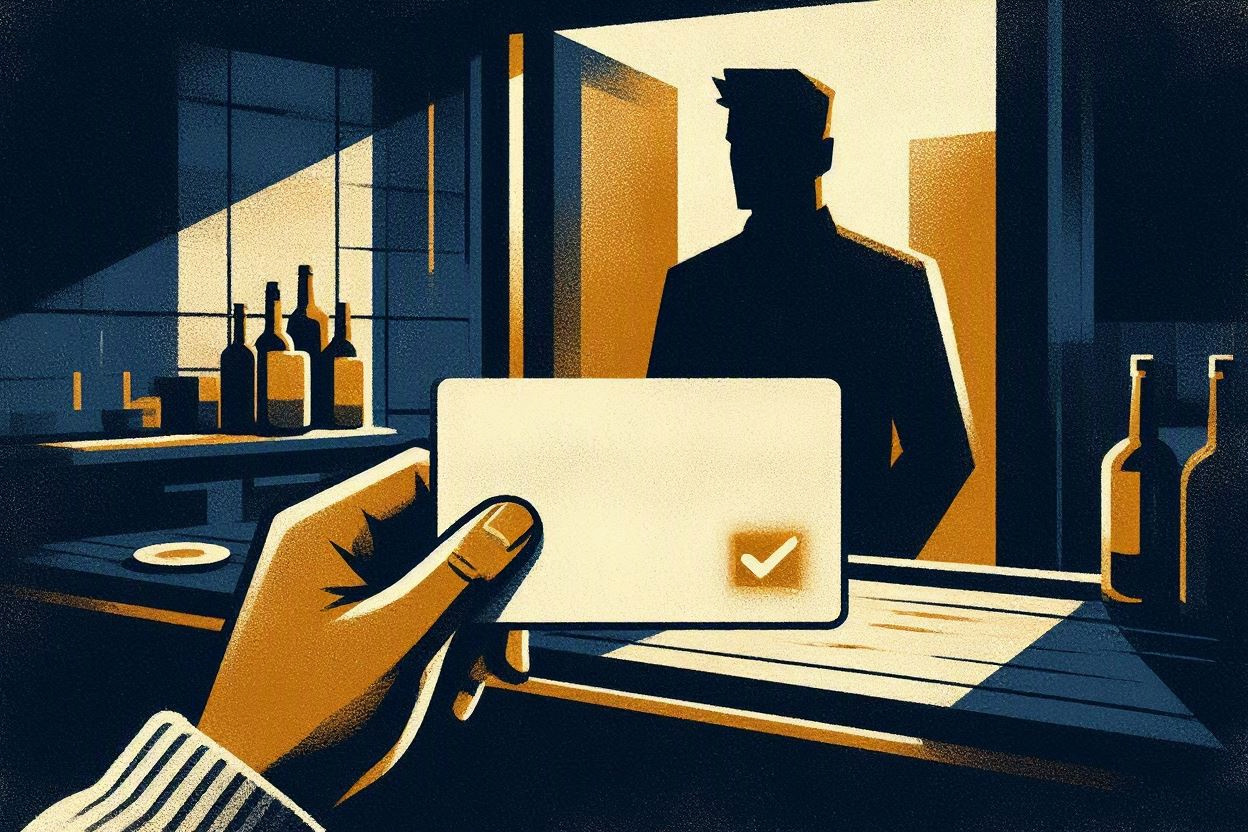
You're twenty-one. You walk into a bar, hand your driver's license to the bouncer. He looks at the birth year, nods, hands it back. You're in. That nod is the entire transaction. Your home address stayed at the door. So did your organ donor status and your full legal name. The bouncer confirmed one fact and forgot the rest. This is how proof has worked in the physical world for as long as proof has existed. A doctor confirms you're healthy enough to work without faxing your medical records to your employer. A notary confirms the signer's identity without reading the document. The physical world runs on selective proof, and nobody thinks twice about it.
Move the same interaction online and the nod vanishes. The internet was built to copy. Every digital verification becomes a full data transfer, because the system doesn't know how to confirm one fact and discard the rest. Prove you're old enough to buy a bottle of wine? Here's your full name, date of birth, home address, and a photograph of your government ID. Prove you qualify for a loan? Here's your entire financial history. Every transaction photographs the entire filing cabinet when all anyone asked was a yes-or-no question.
In October 2025, a breach at Discord's identity-verification vendor exposed roughly 70,000 government ID photos.[1] People had submitted those images to prove their age. The data never needed to exist in the first place. A system that only needed to confirm "yes, over twenty-one" had instead collected names, addresses, and photographs, and when that system was compromised, everything it had collected walked out the door.
Zero-knowledge proofs close that gap. They're a way to mathematically prove a statement is true without revealing the information behind it. The bouncer's nod, made mathematical. A system running a zero-knowledge proof confirms your age without ever seeing a name, a birthday, or an address. The verifier gets the answer and nothing else.
The idea isn't new. In 1985, three researchers published the paper that formalized it.[2] They asked a question that sounds almost philosophical. How much knowledge needs to be communicated for the sole purpose of proving something is true? Their answer was that in many cases, the amount is none. You can prove a statement without leaking any of the information behind it. Elegant mathematics. And for two decades, completely impractical. The proofs were too slow to generate, too expensive to verify. Zero-knowledge proofs lived in academic papers and graduate seminars while the internet grew up without them.
Then the engineering caught up. Starting around 2012, researchers began building proof systems fast enough to run on ordinary hardware. They named them SNARKs and STARKs, each built on different trade-offs in speed, proof size, and security assumptions.[3] You don't need to understand the underlying cryptography to use it, any more than you need to understand credit card encryption to shop online. The gap between "theoretically possible" and "practically useful" took three decades to close. It's closed now.
Policy is starting to catch up. Age verification is the most recognizable application, and the EU is already moving on it. The eIDAS 2.0 regulation requires member states' digital identity wallets to support privacy-preserving disclosure, and the text specifically names zero-knowledge proofs as a technology governments should incorporate.[4] Member states are beginning to pilot systems now. But the applications go well past bar doors. A lender can confirm you qualify for a loan without your bank handing over every transaction from the last five years. An election system can verify that your ballot is valid, counted exactly once, and tied to an eligible voter, all without recording who you voted for. Employers can confirm a medical license or security clearance is current without pulling the holder's full file. Each of these is the same transaction the bouncer understood. Confirm one fact, forget the rest.
The cryptography is built, and it works. What's been missing is adoption, and adoption is a question of incentives. Companies and institutions that currently collect your data have no reason to collect less of it. Custody of your own information has never been the default online, and the infrastructure that profits from the current arrangement won't volunteer to change it.
Blockchains are one place where the incentives already line up. Networks built to verify transactions without trusting a central party have an obvious use for proofs that reveal nothing beyond validity. Several chains run zero-knowledge proofs in production, handling live money under adversarial conditions. Others use them to compress thousands of transactions into a single proof the main chain can verify in milliseconds, solving scaling problems that have nothing to do with privacy. A tool designed for confidentiality turned out to be just as useful for speed.
The bouncer already gets this right without thinking about it. Check one fact, confirm it, move on. We built an internet that demands the whole filing cabinet for a yes-or-no answer, and then we act surprised when those cabinets get stolen. The math to fix it has existed since 1985. The engineering to make it practical exists now. The next breach is already collecting the data it doesn't need.